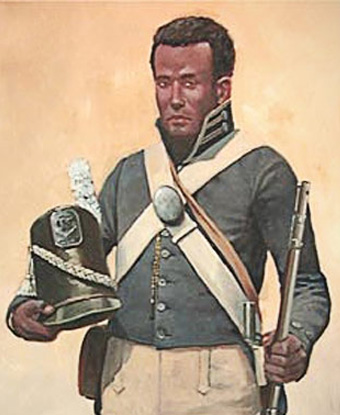
African American Private
1 media/AA private_thumb.jpg 2023-05-29T22:47:02+00:00 Cory Balkenbusch 1813df9caeea31c6742588d0733c7e303d399f25 4 1 Joseph Faudrill served at Fort Wayne for two years. Fort Wayne's status as an integrated fort is an often overlooked part of its rich past. Depicted here is Private William Williams who served at Fort McHenry, but he is dressed in the same uniform that soldiers serving at Fort Wayne would have been. plain 2023-05-29T22:47:02+00:00 NPS via Wikimedia Commons Cory Balkenbusch 1813df9caeea31c6742588d0733c7e303d399f25This page is referenced by:
-
1
2023-01-12T14:46:24+00:00
Old Soldiers and New Farms: the Enlisted Men, 1815-1819
3
enlisted third fort
plain
2023-05-29T22:54:20+00:00
The end of the war meant a return to the monotony of garrison duty for the soldiers at Fort Wayne. However, there were ample opportunities for the soldiers to augment their meagre pay. The enlisted men worked several extra duties that entitled them to additional compensation (and, more importantly to many, extra whiskey allocations). The flurry of construction that came with a new fort (and subsequently new outbuildings) created many of these opportunities. Around a quarter of the Fort’s garrison labored on extra duty at any one time. The majority of the tasks fell under the title ‘carpenter,’ with ‘sawyers’ (those who were tasked with cutting down the trees) being in close second. This would have been backbreaking work for these soldiers. Sections of white oak as long as twenty feet was cut into roughly uniform pieces that were stacked to create the Fort’s structures. To get the timbers from where they were felled to the work site, other soldiers were employed as ‘teamsters.’ These men drove the work teams of either mules or oxen that pulled the heavy timbers to the build site. Finally, soldiers who had prior experience in blacksmithing worked on creating the nails, hinges, locks, and other necessary iron hardware to complete the garrison.[1]
The number of soldiers stationed at Fort Wayne shrank slowly after the end of the war. Not only had the frontier moved further west, so not as many soldiers were necessary, but many men were reaching the end of their enlistments and being discharged. Terms for enlisted men typically lasted five years, so men that had joined during the war were leaving the service as early as 1817. Many of Fort Wayne’s garrison had served multiple terms, especially those serving in the roles of corporal or sergeant. One Sergeant Edwards had been serving off and on since 1781, after enlisting to fight in the American Revolution at the age of 16. Edwards was rather unpopular with his men, as he was frequently insulted and disrespected by the privates in his section.[2] Soldiers reenlisting multiple times also meant that the average age of the soldiers at the Fort was higher than what is associated with the Army today. At 33 years old being the average, Fort Wayne’s soldiers were anywhere between 19 and 50 years old. The men stood at an average height of 5’8” with most of the men coming from Pennsylvania, Maryland, and New York. A quarter of the garrison was foreign born, with most of those foreigners coming from Ireland.[3]
Fort Wayne’s garrison was noteworthy in that it was integrated. Despite the presence of slaves at the Fort sporadically throughout the years, there was at least one African American private that served the post as a free man. Private Joseph Faudrill was in the ranks for only two years, having enlisted in 1813 for the duration of the war. His service life was free of any court martials and he was occasionally employed as a wagon maker, which was his craft before enlisting. After his discharge in 1815, it is very likely that he remained in the area to tend to the wagons of the settlers passing through.[4]
The former soldiers of the Army would form the basis of settlers in the newer territories of the United States. Enlistment land bounties gave discharged soldiers acres to settle for themselves all across Indiana, Ohio, and Illinois.[5] Soldier settlers were perfect for settling the less populated parts of the young country, as their years of experience living on the frontier and fighting meant they needed little governmental support to hold land. These new soldier settlers were the foundation of the early Midwest.[1] Monthly Return of the Garrison of Fort Wayne, January, 1816, Returns from U.S. Military Posts: 1800-1916, National Archives roll 1400.[2] Edwards, Character Files, Historic Fort Wayne Materials, Allen County - Fort Wayne Historical Society.[3] Fort Wayne Garrison 1816 , Historic Fort Wayne Materials, Allen County - Fort Wayne Historical Society.[4] Joseph Faudrill, Character Files, Historic Fort Wayne Materials, Allen County - Fort Wayne Historical Society.[5] See Sergeant William Dougherty, Character Files, Historic Fort Wayne Materials, Allen County - Fort Wayne Historical Society.