Location of the Wells Farm
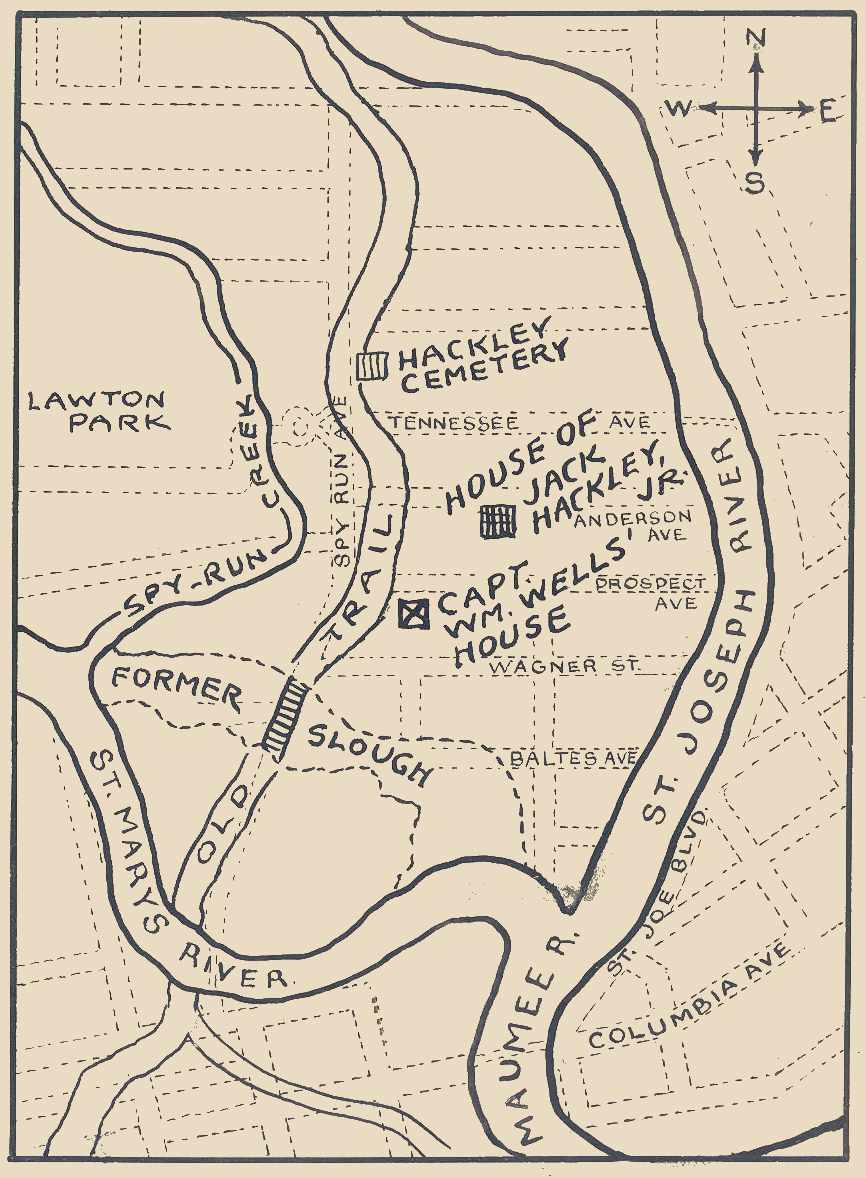
1 media/William Wells Farm, Griswold_thumb.jpg 2023-04-21T15:36:35+00:00 Cory Balkenbusch 1813df9caeea31c6742588d0733c7e303d399f25 4 1 Here Wells' farm and the location of some other early houses in French-Town is juxtaposed onto modern streets in Fort Wayne. Illustrated by Bert Griswold. plain 2023-04-21T15:36:35+00:00 The Bert J. Griswold Collection of Fort Wayne History, Special Collections Division, Allen County Public Library. Cory Balkenbusch 1813df9caeea31c6742588d0733c7e303d399f25This page has annotations:
- 1 2023-04-21T15:38:21+00:00 Cory Balkenbusch 1813df9caeea31c6742588d0733c7e303d399f25 Approximate location of the Fort at this time. Cory Balkenbusch 1 plain 2023-04-21T15:38:21+00:00 Cory Balkenbusch 1813df9caeea31c6742588d0733c7e303d399f25
This page is referenced by:
-
1
2023-01-11T19:16:27+00:00
Trade and Trapping: Euro-American Civilians in the Area, 1800-1815
3
civilians second fort
plain
2023-04-21T15:57:48+00:00
The new century brought further growth of the village around the Fort’s walls. Culture in the region had remained heavily French influenced, even as more settlers moved in. The fur trade too remained dominant, with the region being one of the most lucrative for merchants and government agents throughout the 1800s and 1810s, just as it had been for the Miami and French for centuries. However, beaver, which had once been the dominant product, was beginning to become more scarce. Trade in deer skins and racoon clearly made up for the shortages, but the ecological toll of the fur trade and the American/European thirst for goods was beginning to rear its ugly head.[1]
Proof that the settlement was growing and worth spending time at, at least for the bored soldiers of the garrison, can be found in the Fort’s orderly book. Curfews were set, with soldiers not allowed to visit “any house or Store in French-town after Retreat.”[2] Violation of this order was met with punishment in at least a handful of occasions, with Privates Factor Bingham and William Perkins receiving fifteen lashes for being in the town after hours. Freedom to visit the town for the soldiers was restricted to be between eleven and one because of this incident.[3]
The presence of the military was a natural pull for settlers to move to the area, but even as civilians they were living on federal property and subject to whatever standards the commanding officer saw fit. Sanitation was important as there was inconsistent access to medical care and disease could spread quickly in the small and compact community. It was necessary that the “lots & Streets” were kept “clean and void of all filth or putrefaction” per one garrison order in 1807.[4] Disease came from directly from human sources as well, one report noted:The Surgeon’s Mate of this Garrison will Make a full & true Search into a report that has been represented to the Commanding Officer, that a Certain Sally Becket who has during the Winter been through humanity permitted to reside in this Garrison, is Infected, with the Venereal disorder & Report accordingly… This Order is not to be Made public until the Search is Made, to prevent deception.[5]
This is not the only mention of sex work in the area, as another garrison order from a few years late directed the men to stop fraternizing with “the large Ottoway Squaw.” Those that had were required to visit the doctor.[6] For Sally Becket, the Surgeon’s report brought to the surface a serious outbreak of venereal disease. It was declared that “any Intercourse of whatsoever Nature” with Becket would be punished as a direct violation of orders.[7]
William Wells was one of the more well off settlers in the area, having been offered a parcel of land that was his to purchase (although his children would end up footing the bill) and develop as he wanted.[8] After securing his position as Fort Wayne’s first Indian Agent, Wells earned $1,200 a year and had the opportunity to secure further lucrative private deals providing services and goods for the local Native Americans.[9] Using this income, Wells built a farm nearby the fort, which was worked by slaves he had purchased in Kentucky. Slavery was illegal in the Indiana Territory, but this was seldom enforced. Authorities at the Fort (who often owned their own slaves) were well aware of Wells’ slaves, who had unrestricted access to the post. Presumably this was because the slaves were busying ferrying supplies for the Indian Agency.[10]
Wells’ tenure was not without controversy. This, in part, was due to the establishment of the Indian Factory network in 1802. The Agency had a handful of buildings constructed around the Fort to provide the goods and services agreed to in the various treaties and agreements. $800 was provided for the construction of a house and the new Factory. However, Wells opted to build this complex on his own land across the river from the Fort which greatly inconvenienced cooperation between the garrison and the Agency.[11]
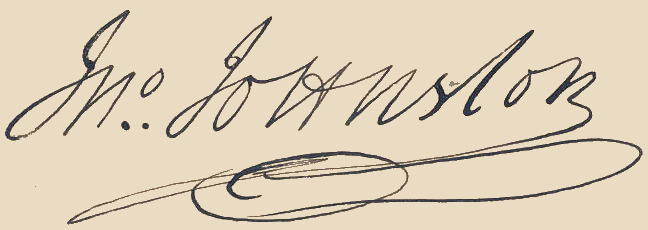
John Johnston was given the position of Indian Factor at Fort Wayne’s ‘Factory,’ a job that had significant overlap with the Indian Agent. Wells, as Indian Agent, was responsible for treaties, negotiations, and reporting on the attitudes of various tribes towards the federal government. Johnston, as Indian Factor, handled economic issues like providing the Native Americans with trade goods. It becomes clear how this system quickly became convoluted and ripe for arguments over authority, something that Johnston and Wells were clearly inclined to do.[12]
An Irishman, Johnston was born on March 22nd, 1775 and immigrated to the United States in 1786. His service to his new country started when he was still young, working as a wagon driver for Wayne’s army. Johnston brought with him to Fort Wayne his wife, sixteen year old Rachel Robinson. The couple were known for being remarkably stoic. This was unusual for the frontier, otherwise filled with those preoccupied on making a fortune or carving out themselves a piece of the west. Johnston earned $1,000 a year plus and additional $365 for expenses. Johnston hoped to treat the Native Americans fairly at his Factory while faithfully executing his duties. This, of course, was not always possible.[13]
Wells faced complaints from all sides, even before Johnston arrived to challenge his authority. William Henry Harrison questioned whether Wells was really doing everything he could to keep the region at peace in the opening years of the new century. Further accusations in 1804 suggested that merchants were getting licenses to sell amongst the tribes without proper vetting whatsoever. He also seemed to be making far more money than an Indian Agent could expect, something that aroused Harrison’s suspicions. Even the famous Shawnee chief Tecumseh called for Wells to be removed directly, blaming him on much of the region’s instability.[14]
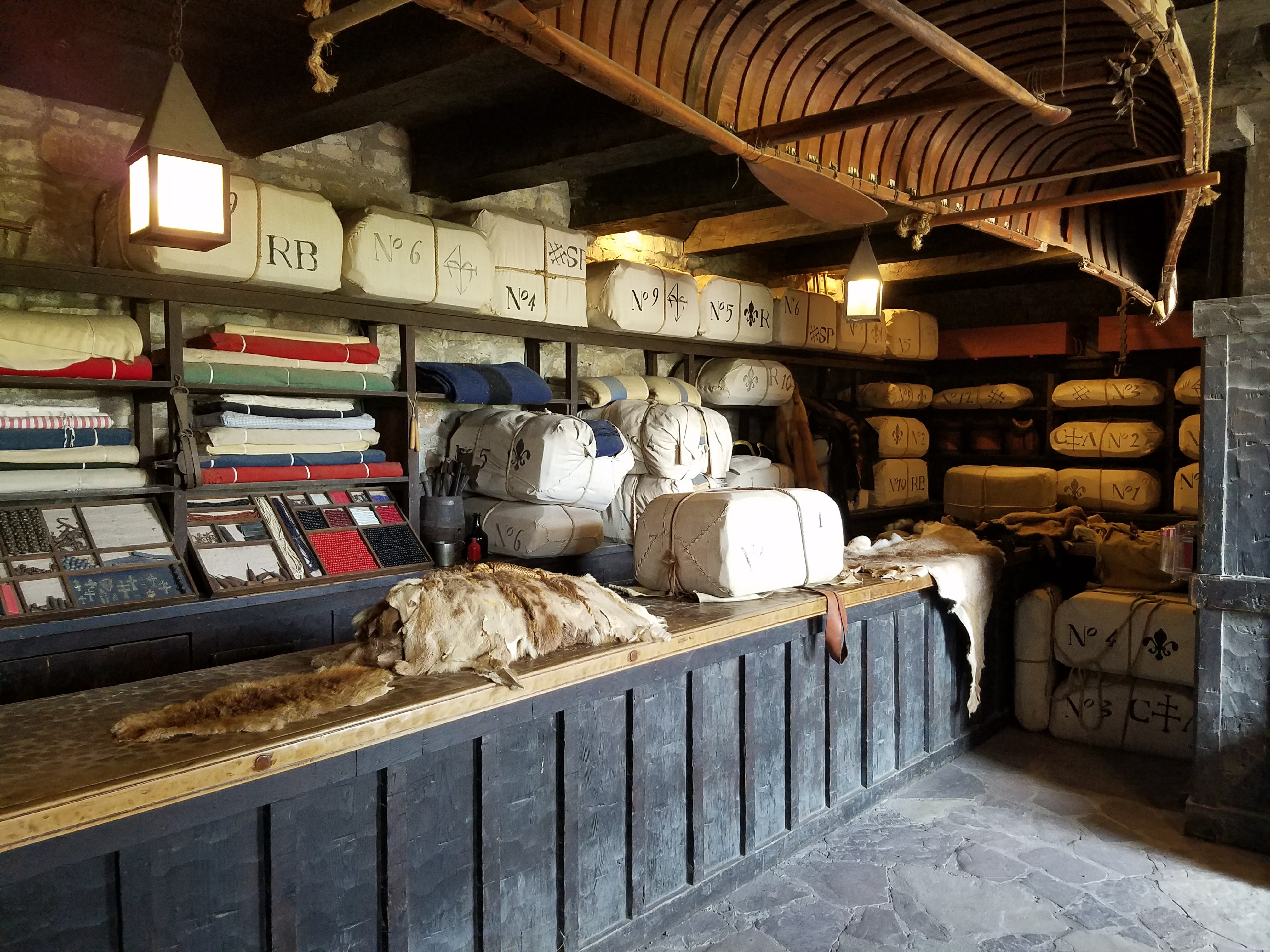
Johnston continued to focus on his duties, even if at the expense of Wells’ career. The factory kept in stock a myriad of goods, including twelve sets of white cups and saucers, two floral cream jugs, twelve women’s horse saddles, blankets, tin kettles, coffee pots, hand saws, and sledgehammers. It is clear that both luxury goods and practical tools were expected to be sold to the Native Americans and civilians around Fort Wayne.[15] Johnston continued to work the Indian Factory until 1811, when he requested a transfer to Picqua, Ohio that was granted.[16]
His successor was Benjamin Franklin Stickney. Stickney was one of Fort Wayne’s more colorful characters. Head of both the Indian Agency and Factory (these roles were consolidated around this time), Stickney was just as disliked as his predecessor. Stickney’s activities will be discussed further in the section on the final fort.[17]
The destruction of the village during the Siege meant that there was little activity of note in the remaining years of the War of 1812. The slow rebuilding process as settlers began to stream in after the war will be highlighted in the final section about the village outside the Fort.[1] Charles Poinsatte, Outpost in the Wilderness: Fort Wayne, 1706-1828 (Fort Wayne: Allen County - Fort Wayne Historical Society, 1976), 42.[2] It is interesting to note that the settlement is almost always referred to as ‘French-town’ in any Fort records. The city does not adopt the name ‘Fort Wayne’ until its incorporation as a town in 1829, despite the fact that most city promotional materials today list the city’s birthday in 1794. The use of the word ‘Retreat’ refers to the end of the military day, when the final roll call is taken and the day’s labor ceases. Fort Wayne Garrison Orderly Book, 4 November, 1803 (as transcribed in Griswold, Fort Wayne: Gateway of the West, 1802-1813, 150.)[3] Fort Wayne Garrison Orderly Book, 16 April, 1807 (as transcribed in Griswold, Fort Wayne: Gateway of the West, 1802-1813, 251.)[4] Fort Wayne Garrison Orderly Book, 23 July, 1807 (as transcribed in Griswold, Fort Wayne: Gateway of the West, 1802-1813, 255.)[5] Fort Wayne Garrison Orderly Book, 21 May, 1803 (as transcribed in Griswold, Fort Wayne: Gateway of the West, 1802-1813, 122.)[6] Fort Wayne Garrison Orderly Book, 28 December, 1811 (as transcribed in Griswold, Fort Wayne: Gateway of the West, 1802-1813, 349.)[7] Fort Wayne Garrison Orderly Book, 24 May, 1803 (as transcribed in Griswold, Fort Wayne: Gateway of the West, 1802-1813, 122.)[8] Griswold, Fort Wayne: Gateway of the West, 1802-1813, 274.[9] Poinsatte, Outpost in the Wilderness: Fort Wayne, 1706-1828, 39.[10] Fort Wayne Garrison Orderly Book, 26 May, 1809 (as transcribed in Griswold, Fort Wayne: Gateway of the West, 1802-1813, 290-291.)[11] Gayle Thornbrough, Letter Book of the Indian Agency at Fort Wayne: 1809-1815 (Indianapolis: Indiana Historical Society, 1964) 12.[12] Poinsatte, Outpost in the Wilderness: Fort Wayne, 1706-1828, 40.[13] Poinsatte, Outpost in the Wilderness: Fort Wayne, 1706-1828, 40-41.[14] William Heath, William Wells and the Struggle for the Old Northwest, (Norman: University of Oklahoma Press, 2015), 288, 291, 312, 313.[15] Griswold, Fort Wayne: Gateway of the West, 1802-1813, 405-411.[16] Griswold, Fort Wayne: Gateway of the West, 1802-1813, 50.[17] Griswold, Fort Wayne: Gateway of the West, 1802-1813, 50.