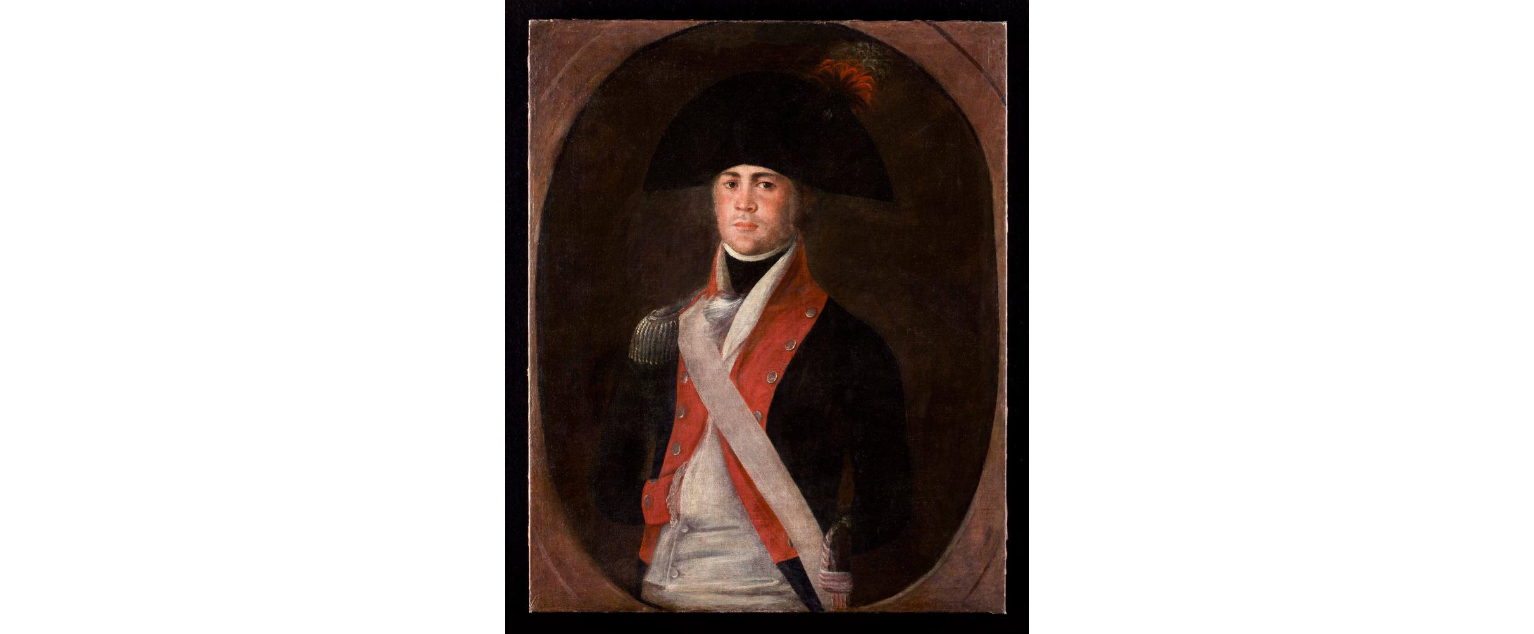
Portrait of Captain William Preston Smith
1 media/army officer portrait_thumb.png 2023-03-01T16:39:27+00:00 Cory Balkenbusch 1813df9caeea31c6742588d0733c7e303d399f25 4 1 While Cpt. Smith did not directly serve at Fort Wayne, this portrait is a good illustration of how an officer should be dressed when on duty. Painting by José Francisco Xavier de Salazar y Mendoza. plain 2023-03-01T16:39:27+00:00 Courtesy of the Colonial Williamsburg Foundation Cory Balkenbusch 1813df9caeea31c6742588d0733c7e303d399f25This page has annotations:
- 1 2023-03-01T16:41:06+00:00 Cory Balkenbusch 1813df9caeea31c6742588d0733c7e303d399f25 Hamtramck wanted his officers to wear their sidearms when on duty. Swords were a symbol of rank more so than a functional weapon by this time. Cory Balkenbusch 1 plain 2023-03-01T16:41:06+00:00 Cory Balkenbusch 1813df9caeea31c6742588d0733c7e303d399f25
This page is referenced by:
-
1
2023-01-11T18:26:16+00:00
Officering the Unruly: Fort Wayne's Officer Corps from 1794-1800
12
first fort officers
plain
2023-04-26T23:59:59+00:00
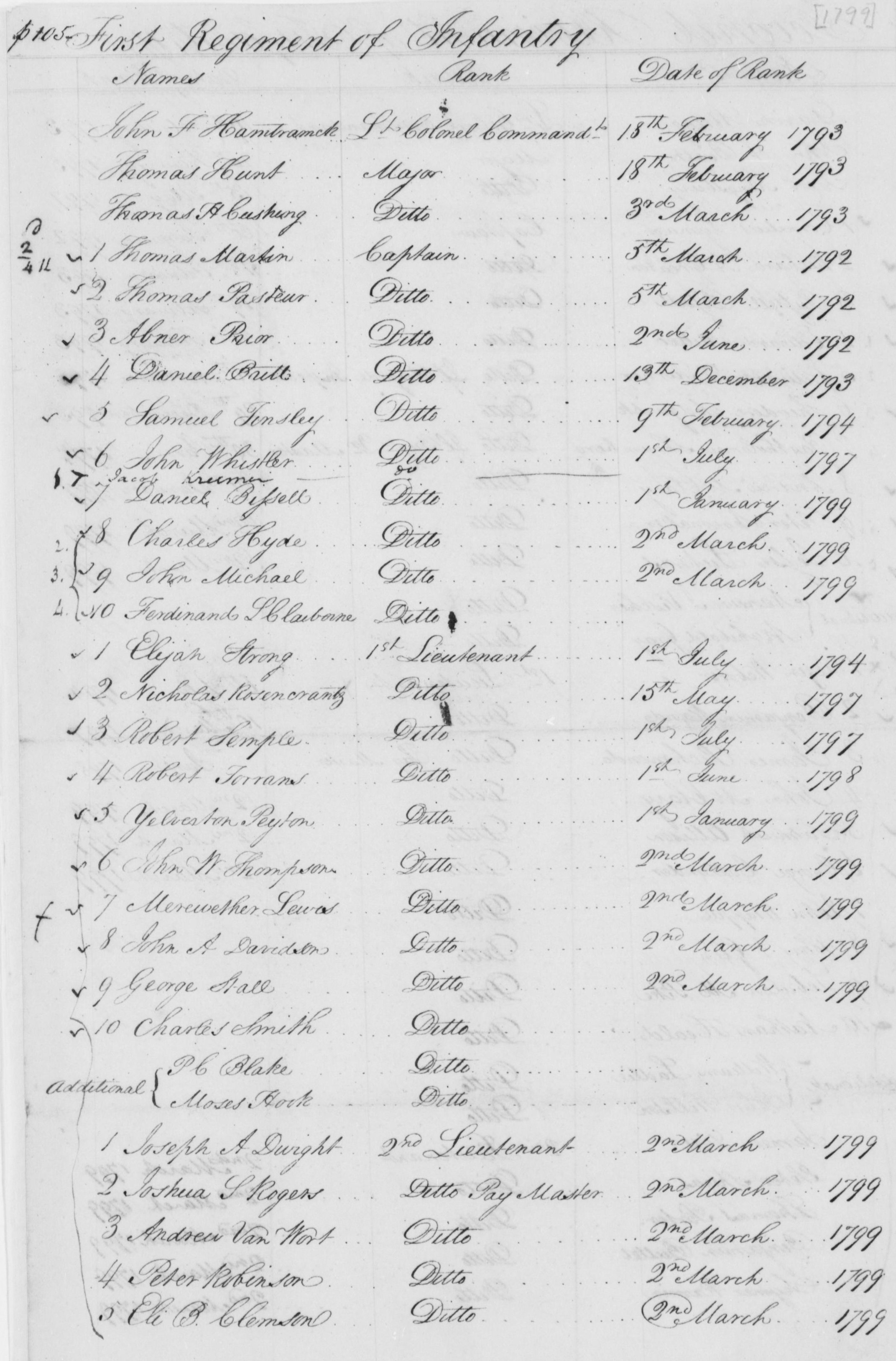
It was somewhat of a dubious honor when Lieutenant Colonel John Francis Hamtramck was assigned command of the new Fort Wayne on October 21st, 1794. Much work remained to be done, as even the barracks lacked roofs. Hamtramck was up to the task. Another veteran of the American Revolution, he had served in the Northwest Territory since the end of the war. Before the Legion had marched, Hamtramck had served as the commander of Fort Knox, located in modern-day Vincennes, Indiana, from 1787 through June of 1793. There he had learned how to balance the many conflicting demands on frontier forts: supply shortages, low morale, the complexities of Native American negotiations, and pleasing French merchants in the area.[1] Hamtramck received some pointers from Wayne as well as his assignment in a letter on October 21st, 1794:
Hamtramck had a myriad of issues to address at his new command in addition to finishing construction. Food stores were low, and many of the men had been on reduced rations for nearly a month while the Fort was being constructed. Discipline issues were also rife. In the very first week of Fort Wayne being an active military post, Hamtramck had strict directions on how those on guard duty were to behave. The strictness was necessary, as ample court martial records show.[3] With only eighteen officers to govern nearly three hundred men (when each of the six companies left to garrison the Fort were at full strength), Hamtramck had to maintain control and respect.[4]You are hereby appointed commandment of this post - which may well be deemed - the key or barrier between the navigable waters of the Gulfs - of Mexico and St. Lawrence as well as between the Indian tribes settled along the margins of those waters, & as such it has always been considered both by the French & British who made it the Grand deposit for their Indian warehouses or stores.
Hence it became a favorite object of Government to possess & Garrison it - in the accomplishment of which much blood & treasure have been expended.
To your charge & Conduct the defense of this important barrier is now committed - with Authority to name the Fort agreeably to your request, in full confidence it will be Maintained to the last extremity…
You will also endeavor to cultivate a good understanding between the Wabash Indians & the United States - so as to admit of a free & safe communication by water from the SW end of the portage Eight miles from this place to Port St. Vincinnes…
Wishing you an agreeable Command. I am with much Esteem & regard Your most Humb Sert. Anty Wayne[2]
Hamtramck seemed to have the men’s respect, despite his strict nature, as he was fair and inspiring when needed. Physically he was not awe-inspiring, standing at only 5’5”, but his intelligence and experience more than compensated for his height.[5] Under him were experienced men that had worked their way up through the ranks. One company commander at the Fort was Captain Jacob Kingsbury. Kingsbury began his military career at the very bottom, enlisting as a private in a Connecticut regiment at the outbreak of the American Revolution. By the end of the Revolution, he had achieved officer status as an ensign before joining the new U.S. Army as a lieutenant in October of 1787. Kingsbury earned a position as a company commander and the rank of captain in the new Legion after his successful defense of Dunlap’s Station in January of 1791.[6]
Another one of the company commanders, Captain Richard Greaton, was also a Revolutionary War veteran, fighting for Massachusetts, and joined the new national army in March of 1791 Greaton fought in the ill-fated campaign under St. Clair, being injured at the infamous defeat.[7] Captain John Reed shared this path as well, being wounded at St. Clair’s defeat and fighting for New Jersey during the Revolution.[8]
These men were not exempt from Hamtramck’s discipline. Recognizing the need for the officers to be easily recognizable in their positions of authority, one garrison order from April 21st, 1795, reminded “the officer of the Day and of the Guard to be in as full uniform as possible, hair well Dressed, and by all means with Boots if they have any, and never with a Short Coats or without their Side Arms During the time they are on Duty.”[9] Hamtramck wanted the men to be lead by example.
In addition to managing the men, the Fort’s officers also kept the civilian contractors in line, who supplied nearly everything to the military. November 30th, 1794, was one example of this. Tired of cost-cutting by contractors providing subpar to inedible food, Hamtramck assembled a council of officers, including Captains Kingsbury, Greaton, and Reed, to examine some beef that had arrived to the Fort, and if it “ought to be received as good and wholesome rations.”[10]
Outside of the military realm, Hamtramck was also a family man. Within a week of the Legion leaving the new Fort, Hamtramck asked Wayne permission to move his family from Vincennes to the new post. His wife, Marie Josephe Edeline, moved by May of 1795. Unfortunately, Marie would drown on a trip back to Vincennes on May 21st, 1796, meaning that when Hamtramck returned to Fort Wayne after a posting at Detroit from July 1796 through July 1797, he had a new wife, Rebecca Mackenzie. Their first child was born April 19th, 1798, and the second less than a year later, on April 8th of 1799. Hamtramck transferred back to Detroit shortly thereafter, taking on a more significant role as commander of the entire Great Lakes region.[11]
Colonel David Strong followed Hamtramck in command, who had been serving as commander at Fort Greenville until 1796. Strong was Legion veteran, who took over as left-wing commander after Hamtramck took command of the Fort. Strong had fought in the Revolution as well and was well suited for the task, working hard to prevent some of the issues of drunkenness and slack discipline that had plagued the troops of Fort Wayne since construction.[12] After a poor inspection by General James Wilkinson, a notoriously corrupt individual that managed to achieve the position of General of the United States Army by 1797, Hamtramck returned from Detroit and Strong transferred north. Whether this switch achieved any noteworthy results is unclear, and by May 16th, 1798, Colonel Thomas Hunt took command of Fort Wayne.[13]
Hunt had fought at the battles of Lexington and Concord, Bunker Hill, and Stoney Point during the Revolution. He joined the U.S. Army in 1793, serving as a Major under Wayne before taking command of Fort Defiance. Hunt noticed the poor repair that the Fort’s buildings were in and determined that a new fort was necessary, as will be discussed in the next section.[14] Hunt also brought his family with him, moving them straight from Boston to the middle of the wilderness. This was the first introduction of Anglo-American upper-class culture to the region.[15]
The final officers worthy of note were the Fort’s first surgeon and the surgeon’s mate. Surgeon John Elliot and his assistant, David Davis, had an immense task cut out for them. The men of the Legion were worn down after a long and difficult campaign. Poor weather and living conditions compounded these issues, with sometimes as much as thirty percent of the garrison sick at any one time.[16] Post surgeons at Fort Wayne were expected to be attentive to all men’s health and sanitation aspects. Hamtramck specifically ordered the surgeons to do a daily inspection, the orderly book reporting that “The Doctor will in future examine the Sick every morning at 7Oclock … after the examination is over the doctor will furnish the Fort Major,[17] with a list of all such have been Discharged from the Sick Report.”[18] However, there were seemingly issues as at one point the government factor, John Johnston (who will be discussed later on), had briefly served as the Fort’s surgeon until a replacement arrived in the form of Dr. Edwards.[19][1] Walter Font, A Garrison at Miami Town: Fort Wayne, October 1794 - June 1795 (Fort Wayne: Allen County - Fort Wayne Historical Society, 1994), 9.[2] Wayne to Hamtramck, 22 October 1794, Wayne Papers, William L. Clements Library, University of Michigan. Transcribed in Font, A Garrison at Miami Town: Fort Wayne, October 1794 - June 1795, 9-10.[3] Font, A Garrison at Miami Town: Fort Wayne, October 1794 - June 1795, 12-17.[4] Emory Upton, The Military Policy of the United States (Washington: War Department Office of the Chief of Staff, 1912), 83.[5] Font, A Garrison at Miami Town: Fort Wayne, October 1794 - June 1795, 90.[6] Font, A Garrison at Miami Town: Fort Wayne, October 1794 - June 1795, 91.[7] Font, A Garrison at Miami Town: Fort Wayne, October 1794 - June 1795, 89.[8] Font, A Garrison at Miami Town: Fort Wayne, October 1794 - June 1795, 91.[9] Ebenezer Massey, Fort Wayne Orderly Book for the years of 1794 & 1795, 21 April 1795, (as cited in Font, A Garrison at Miami Town: Fort Wayne, October 1794 - June 1795, 75.)[10] Massey, Fort Wayne Orderly Book for the years of 1794 & 1795, 30 November 1794, (as cited in Font, A Garrison at Miami Town: Fort Wayne, October 1794 - June 1795, 26.)[11] Font, A Garrison at Miami Town: Fort Wayne, October 1794 - June 1795, 90.[12] Charles Poinsatte, Outpost in the Wilderness: Fort Wayne, 1706-1828 (Fort Wayne: Allen County - Fort Wayne Historical Society, 1976), 34-36.[13] Poinsatte, Outpost in the Wilderness: Fort Wayne, 1706-1828, 37.[14] Poinsatte, Outpost in the Wilderness: Fort Wayne, 1706-1828, 37.[15] Poinsatte, Outpost in the Wilderness: Fort Wayne, 1706-1828, 39.[16] Alan Gaff, Bayonets in the Wilderness: Anthony Wayne’s Legion in the Old Northwest (Norman: University of Oklahoma Press, 2004), 360.[17] The Fort Major was responsible for the daily operations of a post, held by Lieutenant John Wade. Font, A Garrison at Miami Town: Fort Wayne, October 1794 - June 1795, 11.[18] Massey, Fort Wayne Orderly Book for the years of 1794 & 1795, 11 March 1795, (as cited in Font, A Garrison at Miami Town: Fort Wayne, October 1794 - June 1795, 61.)[19] Poinsatte, Outpost in the Wilderness: Fort Wayne, 1706-1828, 33.