Portrait of Captain William Wells
1 media/coll6_836_full_thumb.jpg 2023-03-14T14:33:36+00:00 Cory Balkenbusch 1813df9caeea31c6742588d0733c7e303d399f25 4 1 Wells, pictured here in his Army uniform, has a complex legacy. His impact on the region was profound and highlights the complexities of early American frontier politics. Unknown artist. plain 2023-03-14T14:33:36+00:00 Special Collections Division, Allen County Public Library. Cory Balkenbusch 1813df9caeea31c6742588d0733c7e303d399f25This page is referenced by:
-
1
2023-01-11T18:32:54+00:00
A Settlement under the Fort's Shadow: Euro-American Civilians in the Area, 1794-1800
6
civilians first fort
plain
2023-03-21T15:12:18+00:00
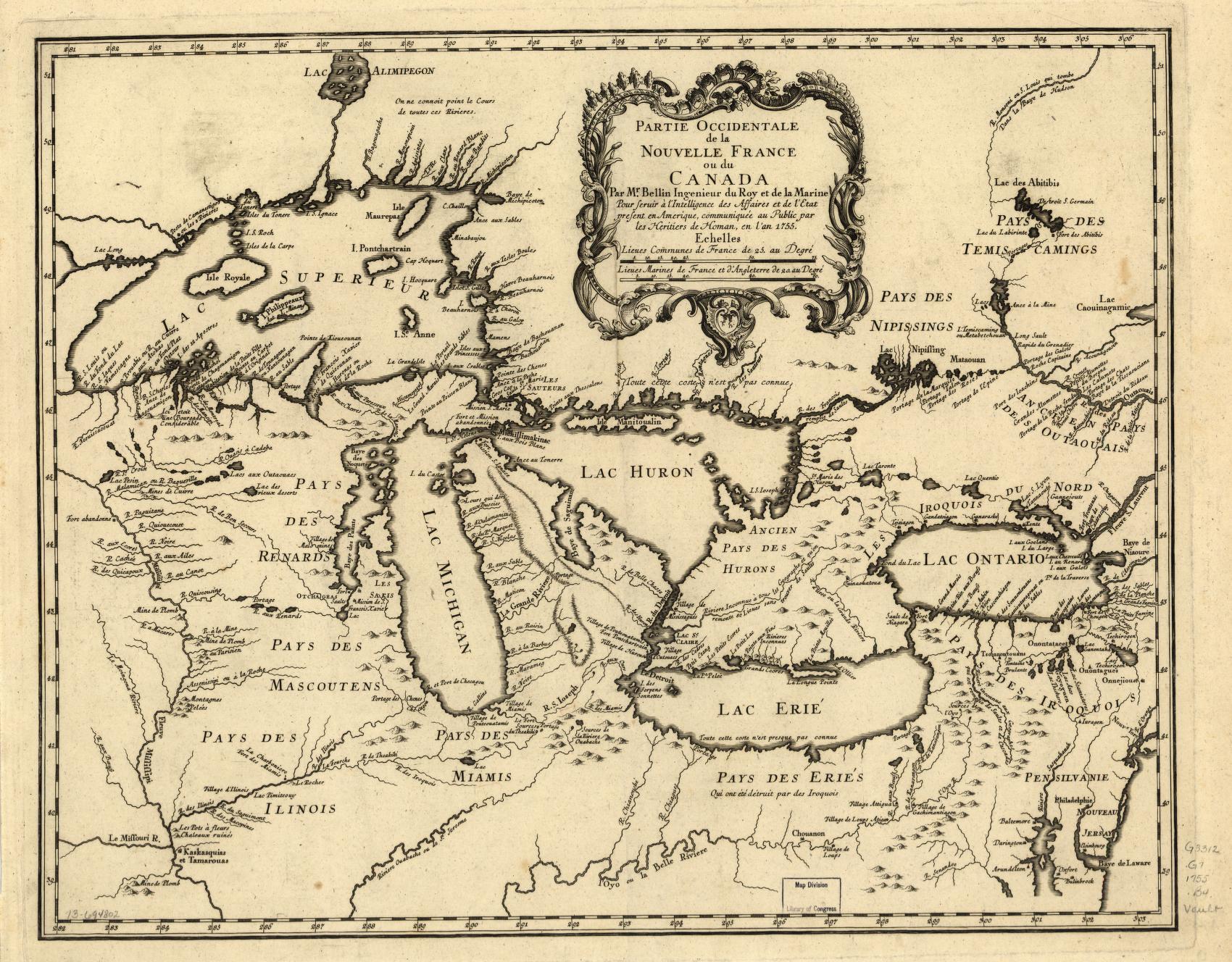
As with any military outpost, Fort Wayne would slowly have a small village grow up outside of it. The confluence of the Three Rivers were ripe for white settlers to move in and make a profit, and many French (or their descendants) fur traders had continued to work and live in the area since Post Miamis. In fact, before the arrival of U.S. troops under Josiah Harmar, the village of Kiihkayonki (Kekionga) was a thriving mixed settlement of French, Myaamia (Miami), Shawnee, and Delaware peoples. This settlement would physically be destroyed twice, once during Harmar’s attack and again during Wayne’s campaign, but the settlement was resilient.[1]
In fact, many of the area’s early white settlers were no supporters of the United States. French influence, from decades of fur trade in the region, still had a powerful impact on the village’s inhabitants. Many were descendants of merchants and fur traders that had simply elected to stay rather than return to France when the territory changed hands following the French and Indian War. Because of this, strong connections with the local Myaamia (Miami) population were common. One man, Antoine Lasselle, even fought alongside the Myaamia (Miami) at the Battle of Fallen Timbers. Lasselle would be captured during the battle and Wayne threatened him with a hanging until Hamtramck intervened.[2] Antoine and his brother, Jacques, had been long term residents of Kiihkayonki (Kekionga), living in the area since 1771. After the town had begun to rebuild following the destruction wrought by the Northwest Indian War, the Lasselle brothers secured a lucrative trade contract the new American fort. This deal likely sweetened their view of Americans, as they went on to help foster better relations between the Myaamia (Miami) and the U.S. garrison.[3]
One of the most interesting characters of the reinhabited village was William Wells. Wells has a complex legacy, having fought for both the Myaamia (Miami) and the U.S. in his life. Born in 1770, Wells was fourth generation American, his family having lived in Virginia since 1700. As tobacco farming became less lucrative, Wells’ father, Samuel, moved the family west to what is now Everson, Pennsylvania in 1767. William was born in one of the most hotly contested regions at the time, as conflict between local Native Americans, American squatters, and British troops was frequent and violent. His father would fight in the Revolution at Fort Pitt, before moving William, his wife, and his six other children to Kentucky following the war.[4] Like many frontier families, the children were actively involved in hunting and foraging around the family farm. William’s older brother Sam and his father both served in the militia, bringing back stories of fighting against Native Americans to eager ears. After his both of his parents died in one of the countless frontier skirmishes, William would take more roles on within the family as his older brother Sam became the head of the household. Keeping the family fed, including fishing, were part of these new responsibilities. A fishing trip in the spring of 1784 took an unexpected turn, when Wells and some friends were discovered by a mixed Delaware and Myaamia (Miami) warriors and taken into the wilderness.[5]
The adoption of captured children was common practice amongst the tribes in the Midwest, seen as a way to replace losses in war. Speaking English was discouraged, as the sooner an adoptee began speaking the tribe’s language the sooner they could be integrated. Wells seemed to integrate well, taking part in every day Myammia (Miami) life and contributing to his new village along the Eel River.[6] In fact, he had two separate Myaamia (Miami) names: Wild Carrot, before he turned eighteen, and Blacksnake upon becoming a man.[7] It was also around this time that Wells would have begin fighting in war parties.
Wells was an experienced warrior by the time he entered the scene at the new Fort Wayne, having fought alongside the Myaamia (Miami) and Mihšihkinaahkwa (Little Turtle) during the campaigns of St. Clair and Harmar, before fighting alongside the Legion of the United States as a scout for Anthony Wayne. His reasons for abandoning the Myaamia (Miami) family he had created, including two Myaamia wives, are unclear. However, he and Mihšihkinaahkwa (Little Turtle) would continue to work together closely during treaty negotiations and it was upon Mihšihkinaahkwa’s insistence that Wells would be appointed the first interpreter at Fort Wayne.[8] Wells would go on to build a farm outside the walls of the fort, which will be discussed more in the next section on the Anglo-American settlement.
The trade based community outside the walls would continue to grow, thriving off the business the Fort brought to it. In fact, it even became necessary for the Army to stipulate prices of certain goods to prevent soldiers from being exploited.
Even on the frontier, luxuries like chocolate and Madeira were available to paying customers. This settlement in the shadow of the Fort would remain a permanent fixture for the years to come.The undersigned have established the Prices of the several articles of Groceries to be sold at this Cantonment (Greenville), and at Fort Wayne as follows-
French Brandy per Gallon - 37/6
Spirits Do - 37/6
Madeira Wine Do - 50/
Sherry Wine Do - 37/6
Best Brown Sugar p. lb. - 4/6
Country made Do - 3/9
Coffee Do - 4/6
Loaf Sugar Do - 6/6
Chocolate Do - 4/6[9][1] George Ironstrack, “The Mihši-maalhsa Wars – Part II,” Myaamia Center of Miami University, last modified March 31, 2014, https://aacimotaatiiyankwi.org/2014/03/31/the-mihsi-maalhsa-wars-part-ii/.[2] Charles Elihu Slocum, History of the Maumee River basin from the earliest account to its organization into counties, (Indianapolis: Bowen & Slocum, 1905), 215. Accessed via the Library of Congress.[3] Charles Poinsatte, Outpost in the Wilderness: Fort Wayne, 1706-1828 (Fort Wayne: Allen County - Fort Wayne Historical Society, 1976), 28-29.[4] William Heath, William Wells and the Struggle for the Old Northwest, (Norman: University of Oklahoma Press, 2015), 12-17.[5] Heath, William Wells and the Struggle for the Old Northwest, 30-35.[6] Heath, William Wells and the Struggle for the Old Northwest, 49-53.[7] Heath, William Wells and the Struggle for the Old Northwest, 61.[8] Poinsatte, Outpost in the Wilderness: Fort Wayne, 1706-1828, 30-32.[9] Walter Font, A Garrison at Miami Town: Fort Wayne, October 1794 - June 1795 (Fort Wayne: Allen County - Fort Wayne Historical Society, 1994), 43.